- OpenResume-Builder-2.2.6-arm64.dmg 115 MB 1 downloads
- OpenResume-Builder-2.2.6-x64.dmg 117 MB 1 downloads
- OpenResume-Builder-2.2.6.AppImage 123 MB 1 downloads
- OpenResume-Builder-Portable-2.2.6.exe 101 MB 2 downloads
- OpenResume-Builder-Setup-2.2.6.exe 101 MB 345 downloads
Resume: offline open-source builder
A local resume builder that runs on hardware you control keeps drafts, snapshots, and PDF exports on your desk instead of a signup funnel. The MIT desktop resume app from the Abhisek571 GitHub project does that work: take the current Setup exe from GitHub Releases or the verified winget id, install it, then edit your resume without creating an account.
- Edit a resume offline after install
- Keep drafts and PDF exports on your own desk
- MIT client with PDF, Word, and plain text export
By Sheet Quill editorial team Current release, published July 2, 2026
Install OpenResume Builder 2.2.6
Windows
Paste into PowerShell or Windows Terminal:
winget install -e --id AbhisekkumarShandilya.OpenResumeBuilderPackage: Microsoft winget community repo (manifest AbhisekkumarShandilya.OpenResumeBuilder on this review date). Installer UNVERIFIED on a real Windows machine..
Other Windows commands
Or download the file directly from the official GitHub release:
Download Windows installer (.exe)Also on this release: Portable .exe (no install)
Windows 10 or 11, 64-bit. Prefer OpenResume-Builder-Setup-*.exe from the current Abhisek571/openresume-builder tag, or the winget id above when App Installer is available.
macOS
Paste into Terminal:
OpenResume-Builder-*-arm64.dmgPackage: GitHub Releases Apple Silicon dmg OpenResume-Builder-*-arm64.dmg on Abhisek571/openresume-builder. No Homebrew cask was found on formulae.brew.sh on this review date; do not invent one. DMG install UNVERIFIED on a real Mac..
Other macOS commands
Or download the file directly from the official GitHub release:
Download Apple Silicon .dmgAlso on this release: Intel Mac .dmg
macOS with Apple Silicon or Intel. Prefer the arm64 or x64 dmg that matches your chip from the current tag. Builds are unsigned; Gatekeeper bypass is documented upstream.
Linux
Paste into your terminal:
chmod +x OpenResume-Builder-*.AppImage && ./OpenResume-Builder-*.AppImagePackage: GitHub Releases OpenResume-Builder-*.AppImage on Abhisek571/openresume-builder. No snap or Flatpak id was found on this review date; do not invent one. AppImage launch UNVERIFIED on a real Linux desktop..
Other Linux commands
Or download the file directly from the official GitHub release:
Download Linux AppImageA 64-bit desktop Linux session. Prefer OpenResume-Builder-*.AppImage from the current tag. Some distros need libfuse2 for AppImage mount.
Every file comes from Abhisek571/openresume-builder v2.2.6 on GitHub, the project's own release, unmodified.
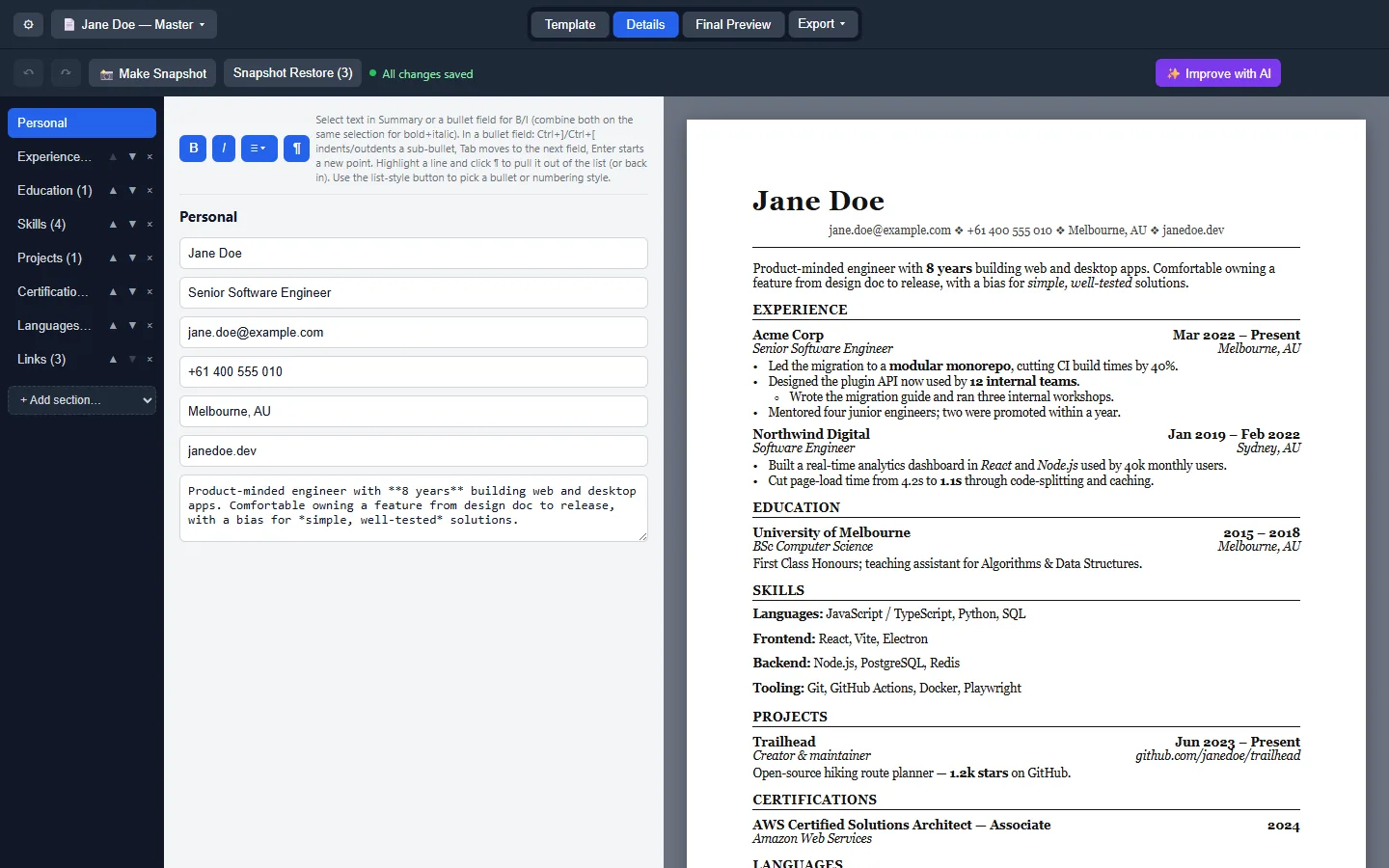
People searching for an installable resume builder usually want a resume tool they can install and trust, not another advertising page that wraps a store listing. Keep this resume install on GitHub Releases when you want a named Setup exe, prove one local resume export, then change templates only after that path works.
Here a resume job means a document you edit, export, and own as files on disk. The MIT product this guide maps is the desktop client on Abhisek571/openresume-builder. The release door is GitHub Releases. Safe download path: download-safe path. Repo layout: GitHub overview. Which file: releases.
What the job needs
Hiring seasons need software that can hold Experience, Education, and Skills, switch templates without losing content, and export PDF plus ATS-friendly plain text. You choose a local client, keep sources on Releases, and avoid surprise toolbars mid-setup. A desktop builder reduces logins that only work while a vendor account stays up.
The app keeps that work on your machine. You install once, create a profile, fill sections, pick a template, export, and leave the window running. The everyday win is fewer half-finished “best download” pages than chasing a new website for every application.
MIT builds
The project license on GitHub reports MIT for source. Free open-source resume downloads cover the Setup exe on the current tag. Safety notes: is it safe.
GitHub Releases door
Windows Setup and Portable, macOS arm64/x64 dmg, and Linux AppImage ship on the current tag. Prefer those exact patterns. No Homebrew cask was found on this review date.
Offline first
The product autosaves profiles on your desk. Cloud signup is not required before the first export.
- Prefer GitHub Releases or the verified winget id over adware portals.
- Match the Setup filename on the tag before you image a shared desk.
- Prove one local PDF export before chasing Word or plain-text variants.
- Write the update door beside the OS version on the machine ticket.
Why this desktop path
Microsoft Word still wins when you already live in that office habit and need mail-merge extras. Canva still wins when you cannot install software and already pay for Pro. Choose this path when you want an MIT client that can edit offline without a design-account login and still export PDF, Word, and plain text from the same profile.
The resume client also covers multiple profiles, named snapshots, dark chrome with a paper-white preview, and three templates with live thumbnails. Docs: project wiki. First hour: installed.
Install by operating system
| OS | Primary door | Notes |
|---|---|---|
| Windows | winget install -e --id AbhisekkumarShandilya.OpenResumeBuilder or Setup exe | Prefer Setup from Releases or winget; Portable exe available; installer UNVERIFIED on a real PC |
| macOS | OpenResume-Builder-*-arm64.dmg / x64 dmg | No Homebrew cask found; unsigned; Gatekeeper right-click Open; UNVERIFIED |
| Linux | OpenResume-Builder-*.AppImage | No snap/Flatpak found; chmod +x then run; may need libfuse2; UNVERIFIED |
Windows detail: install on Windows. macOS: install on macOS. Linux: install on Linux. Machine chooser: for this computer.
Eight steps to first export
- Open GitHub Releases for Abhisek571/openresume-builder. Confirm you are on a stable tag that ships the Setup exe, not a renamed mirror from a review portal.
- Pick the Windows Setup or winget id first. Prefer the Setup exe, or run winget install -e --id AbhisekkumarShandilya.OpenResumeBuilder when App Installer is available. Portable exe is the no-install alternate.
- Clear SmartScreen if Windows warns. Unsigned builds may show More info → Run anyway. Stay on the GitHub Releases or winget door so the binary matches the tag.
- Launch and create a profile. Open the app, create a New profile, and confirm autosave status appears. Keep one master document before you duplicate tailored copies.
- Choose Classic, Modern, or Resumatic. Open the template gallery, pick a layout, then fill Experience, Education, and Skills. Watch the paper preview update as you type.
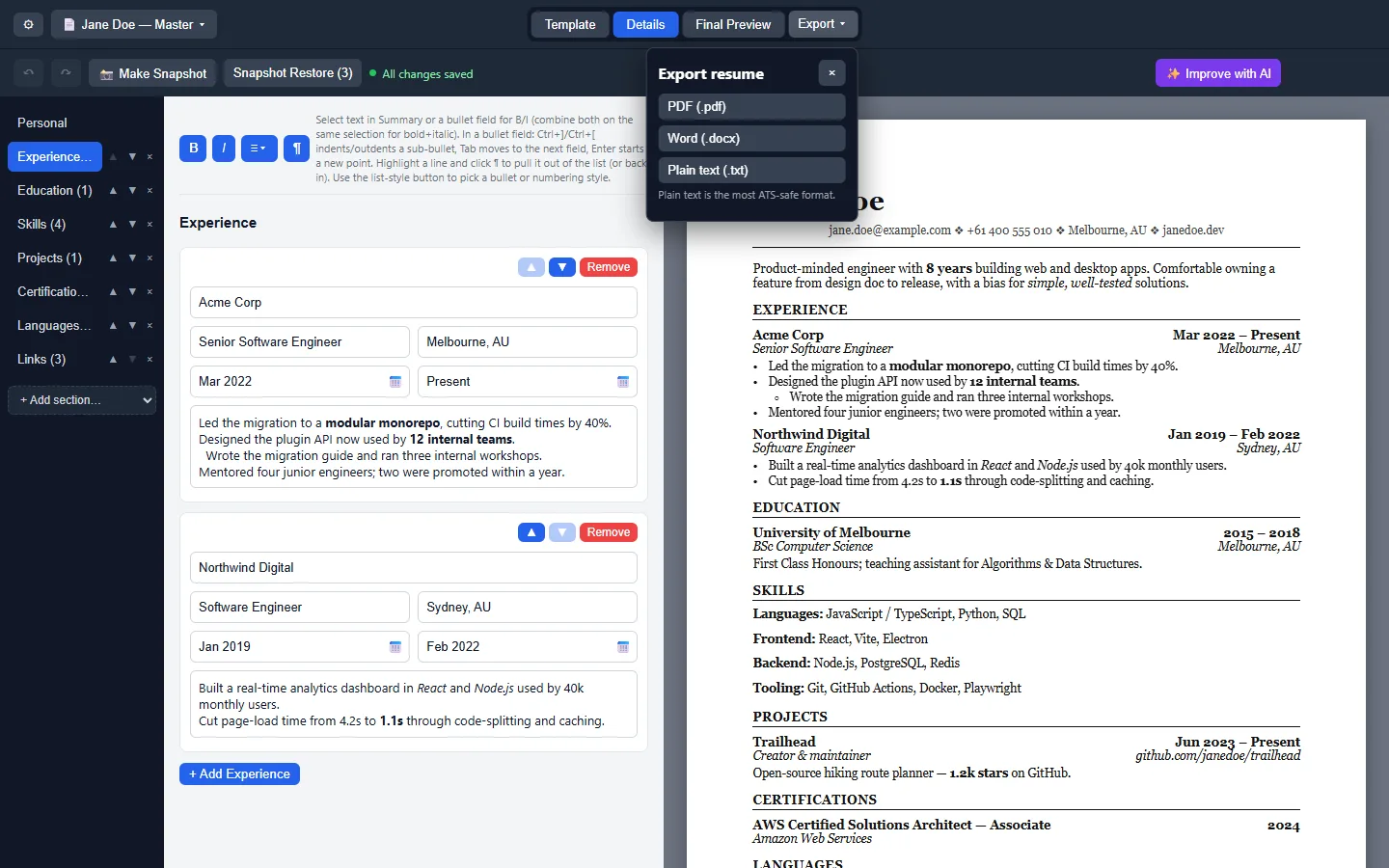
- Export PDF, Word, or plain text. Use the export menu for PDF, .docx, or .txt. Plain text is the ATS-safe format when a portal rejects fancy layouts.
- Save a JSON backup and a named snapshot. File → Save As keeps a portable .json. Snapshots let you restore an earlier draft without losing the current profile.
- Optional macOS dmg or Linux AppImage. No Homebrew cask was found. Prefer arm64 or x64 dmg on Mac, or the desktop client-*.AppImage on Linux. Those paths remain UNVERIFIED on real hardware here.
After those steps, keep one resume install door forever. A second resume download from a portal is how desks end up with two clients. Mixing adware wrappers with GitHub Releases on the same PC creates duplicate installs and confused uninstalls. Guide: first run.
First hour after install
Open one profile, fill a short Experience entry, export PDF once, and try plain text before you trust an ATS portal. Keep JSON backups under a folder you control. Template experiments wait until that first export finishes cleanly. Checklist: installed.
Optional dark mode and snapshot names can wait. The first hour is proof that your binary matches the tag you intended.
How to choose a builder
Pick Word when you only need that office habit and already trust that vendor. Pick Canva when you cannot install software. Pick Google Docs when collaborators must comment in a browser. Pick this client when you want named Releases assets and offline profiles with PDF, Word, and plain-text export.
- Need offline profiles plus ATS plain text on one desk → the MIT client
- Need vendor support seats → keep Word or Canva Pro
- Need zero install → browser makers only
Longer comparison: vs Word. Switch notes: switch from Canva.
Compared with other options
The table below is a desk comparison, not a ranking of store listings. Word wins at office habits. Canva wins at browser design. This client wins at local play with public source.
| Product | Price | Open source | Offline | Signup required | Verdict |
|---|---|---|---|---|---|
| MIT desktop client | Free (MIT) | Yes | Yes | No | Local builder this guide maps |
| Microsoft Word | 365 / one-time | No | App | Often Microsoft account | Classic office habit |
| Canva | Free + Pro | No | Browser | Account | Design-first web tool |
| Google Docs | Free with Google | No | Limited | Google account | Collaborative draft, weak ATS tooling |
| LinkedIn PDF | Free with LinkedIn | No | No | LinkedIn account | Profile export, not a full editor |
A resume desk install is the right fit when you want named Releases assets, offline edits, and resume files you can back up yourself.
Word still wins when purchasing requires office support. Canva still wins when install rights are missing. Docs still wins for comment threads. This path wins when you want named Releases assets and resume files on disk. Longer comparison: vs Word.
Free client vs paid seats
The desktop app itself is free under MIT. GitHub Releases assets named above have no paywall. You may still pay for Canva Pro or Microsoft 365 if you keep those apps as a fallback for design or office workflows.
Commercial builders sell templates and sometimes AI rewrite seats. Those purchases do not replace a local client, and this guide does not sell those seats. If you already have a Canva Pro or 365 licence, keep it until a local habit sticks.
Mistakes that undo an install
Downloading a second adware portal copy to fix a blocked first run. Inventing a brew cask when none was found. Skipping the first local PDF and jumping into five templates. Mixing a portable exe with the Setup install on the same user without notes.
- Take Setup or winget from GitHub Releases / winget-pkgs, not a renamed portal.
- Prove one local PDF before chasing Word or plain-text variants.
- Write the update door on the machine ticket.
- Keep Canva or Word as a fallback, not as the installer.
- Do not invent a brew id that was not found.
Fix each mistake the same way: one honest door, one proven resume export, one documented path. Switch habits: switch from Canva.
Guides index
Install guides cover Windows, macOS, Linux, and the portable Windows exe. Setup guides cover first run, profiles, templates, export formats, ATS plain text, safety, and update/uninstall. Comparison and switch pages help when Canva or Word is already in use. Browse all: guides.
Repeatable desk habits
Write the update door on the machine ticket beside the OS version. Windows Setup, portable exe, macOS dmg, and Linux AppImage are different doors. Mixing them without notes creates duplicate installs and confused uninstalls after a reimage.
Career-center PCs, freelancer laptops, and lab images all benefit from the same boring rhythm: one installer door, one documents folder, one documented export path. That is how a local habit stays boring for everyday desks in a good way.
Everyday limits
The client does not replace a full graphic-design suite. It does not invent job-specific keywords for you. It does not remove the need to trust the Setup you downloaded. Offline use still needs network for the first download and for optional update checks.
Settings that matter early
Profile name, template choice, and whether you keep JSON backups matter more than decorative chrome. Prove a local resume PDF before you chase snapshot libraries. Profiles guide: profiles and templates.
After the first export
Only after one resume PDF works should you add Word export, plain text for ATS, or a macOS/Linux secondary install. Keep Releases bookmarked. Prefer the same tag family that still ships the Setup exe. Update guide: update uninstall.
Keeping the job name clear
Here resume means a local client you install and operate. A review portal that only ranks for the head term is still the wrong binary. Prefer the named Setup exe or the verified winget id, then prove one resume export before you change templates.
When someone pastes a random “best download” link into chat, ask for the GitHub Releases URL instead. The install path on this guide always returns to the upstream GitHub project.
Remember the job name: resume here means a local desktop client plus files you control. An adware download portal mirror that only ranks for the head term is still the wrong binary. Prefer the named Releases Setup or winget id, then prove one PDF before you duplicate profiles.
Commercial seats still win when purchasing requires vendor support. Browser-only builders still win when install rights are missing. Word still wins for operators who already live in that office habit. Choose this client when you want exact Releases names and a desk path that does not start with a signup.
Sheet Quill publishes the install guide. Upstream remains under MIT on GitHub. When Releases change which OS assets appear, re-check the live list before you image a lab.
Lab and travel notes
Travel laptops benefit from a single documented installer door written beside the documents folder. Lab images drift when someone installs a second mirror during a blocked SmartScreen prompt. Prefer returning to the same Releases URL instead of inventing a new download mid-flight.
Career-center machines should receive the client on hardware they control, plus a shared note for the update door. Shared desks should keep Word or Canva available as a fallback until the local habit sticks for the whole room.
Classroom images should pin the exact Setup filename beside the OS version. After every reimage, prove one short local PDF before you call the machine ready. That habit catches vanished portable folders and adware shortcuts that reappear from old bookmark exports.
Command-line users who already live in AppImage workflows can keep that Linux path. Treat the Windows Setup as the windowed path for teammates who need the named release asset. The two can share habits when the room documents which path is official for demos.
Workshop pacing
Career-center workshops run smoother when the projector shows the Releases URL and the winget id before anyone opens a browser search. Attendees who start from a search ad often land on adware wrappers that look similar to the Setup name. Staff should walk the room once during SmartScreen prompts so nobody “fixes” a warning with a second download.
Loaner laptops should already carry the approved binary when policy allows. When policy blocks executables, say so up front and keep Word available as a temporary path. Honesty about policy beats a failed live install in front of thirty people.
Support ticket fields
Useful tickets include the operating system, the exact filename, the download URL host, and whether SmartScreen or Gatekeeper appeared. Screenshots of error dialogs help only after those four facts exist. Volunteers can then tell a Releases problem from a mirror problem in one glance.
If winget fails, capture the winget show output for the known id. If the AppImage fails, capture the terminal line and whether FUSE packages are present. Those details shorten the path to a real fix.
What a resume desk install is for
A resume desk install is for people who want a resume file they can reopen tomorrow without a browser tab. Use the resume client to draft, adjust a resume template, and export a resume PDF you keep on the same machine ticket as the install door.
When a resume needs a second format, export Word or plain text after the resume PDF already looks right. That order keeps a resume review from chasing three half-finished files at once.
Teams that share a resume workshop should print the Releases URL on a slide and say the resume job out loud: one resume install, one proven resume export, then optional extras. Keep a spare resume USB only as a fallback when a desk cannot reach GitHub; the primary resume door stays Releases or winget. Label the USB with the resume tag you installed.
How do I install resume tools on Windows?
Download the current OpenResume-Builder-Setup-*.exe from GitHub Releases for Abhisek571/openresume-builder, or run winget install -e --id AbhisekkumarShandilya.OpenResumeBuilder when App Installer is present. Portable exe is the no-install alternate for a Windows desk. Guide: install on Windows. Keep one door so the next client bump stays honest.
Where should I download a resume app?
Prefer GitHub Releases when you need a resume Setup exe, or the winget id that resolves in microsoft/winget-pkgs. Skip adware download portal wrappers that rename the setup for a search ranking. Details: download safe. Keep downloads on the project release list so the binary matches the tag you expect.
Is this resume software free?
The desktop resume client is free under MIT. GitHub Releases assets named above have no paywall. This guide does not sell Canva Pro or Microsoft 365 seats, and subscription ads or paywalls stay separate from that client licence. Docs and source stay on the public GitHub repository.
Can I switch into this resume builder from Canva?
Yes. Install the MIT client, re-enter the same experience and education text you already keep, then keep Canva as a fallback if you still want that design window. Guide: switch from Canva. Comparison context: vs Word. Canva layout layers do not transfer into the desktop profiles automatically.
Does the desktop resume builder work offline?
After the first download, the app can edit and export a resume offline with the installed Windows build already on disk. You still need network for the first fetch, and for optional update checks later. Offline habits: first run and first hour. A desk install does not require a store account.
Official releases
All releases on GitHub- GitHub stars
- 1
- Downloads, last 2 releases
- 507
- Latest version
- 2.2.6
1.1.0
v1.1.0
- OpenResume-Builder-1.1.0-arm64.dmg 114 MB 1 downloads
- OpenResume-Builder-1.1.0-x64.dmg 116 MB 1 downloads
- OpenResume-Builder-1.1.0.AppImage 122 MB 1 downloads
- OpenResume-Builder-Portable-1.1.0.exe 100 MB 1 downloads
- OpenResume-Builder-Setup-1.1.0.exe 100 MB 153 downloads
Counts come from the GitHub API at build time and only cover the * tags shown here. Package managers (winget, Homebrew, Snap, Flathub) and app stores are not included.